Digital Ethnographies of Individuals and Communities
Algorithmic identities shape what is and is not possible for us to do online.
If our Google preferences (which are constantly recalibrated) highlight to Google that we are primarily interested in skateboarding, then we are sent information about skateboarding at the expense of other information that we could be receiving.
Clearly, many factors contribute to what search results we see.
Activity 1: Reflecting on Sumpter's Method
We were asked last week to follow Sumpter's ‘method’ of finding 32 of your friends on social media, categorising their last 15 posts into an assigned list of categories, and then plotting some of those categories against each other to produce 3-5 2D graphs.
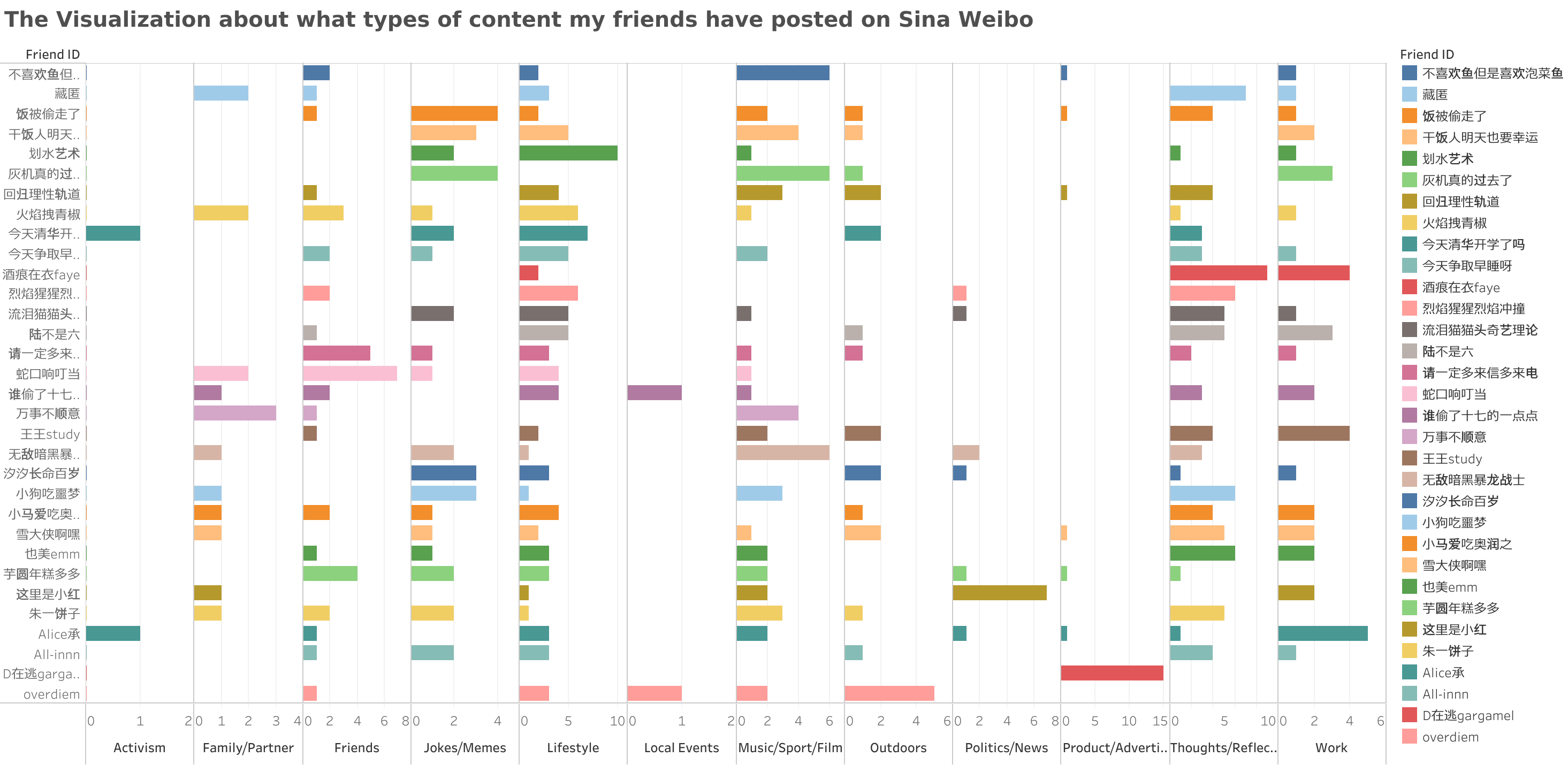
As shown, I chose to produce a 2D graphs containing all the information I collected from my friends on Sina Weibo, and I will explain why I change the method.
Based on the data and visualisation, I could make three statements:
(1)The majority of my friends are less keen on activism, local events and product&advertising, while they posted a lot of contents about lifestyle, thoughts/reflections, music/film/sport, work, etc.
(2)Sina Weibo is an appropriate platform to express users' thoughts and make complaints about their life and work.
(3)People would like to share more types of contents compared "strong-relationship" platform like Wechat.
As for why I change the method, I think the graph is just suitable for Sumpter's article and serves to his arguments, and I could not find the exact visualisation approach in the article, so I think the applied graph was manually painted and tricky for us. In addition, I think my own visualisation method is able to accommodate a greater amount of information, such as carrying IDs, quantities, and types at the same time, as well as helping clarity for the reader through colour differences. If we were to use sumpter's method, we would have to do a very cumbersome visualisation, which is not conducive to making more conclusions
In fact, I think that Sumpter's methodology is a little bit subjective, as I didn't find a qualified criterion for defining content, such as how to differentiate between politics, local events and activism, when filling in and summarising my statistics.
In addition, I think that due to the differences in information regulation between different social media platforms and in different countries.
Sumpter's stats category may not be suitable for multiple platforms.
For example, when I observed content on Sina Weibo, I found that my friends seldom posted sensitive, radical and inflammatory content, as the producers of political, social and other opinion-forming content on Weibo are often governments, organisations and media.
Another aspect that is affected by subjective factors is that when I wanted to modify the statistical categories, I found that I had no
Activity 2:Ethnographies of Digital 'Communities'
Based on my own hobbies and experiences, I chose to investigate the fitness community on Tik Tok. However, the platform itself does not have a "community" function or section, only fan groups run by the influencers themselves(optional). However, I do not intend to regard the fan groups as 'communities', as the users in the fan groups are likely to be common fans of the same type of influencers, which would lead to a high degree of overlap in the analysis. Therefore, I prefer to define Tik Tok's community as an "invisible community".
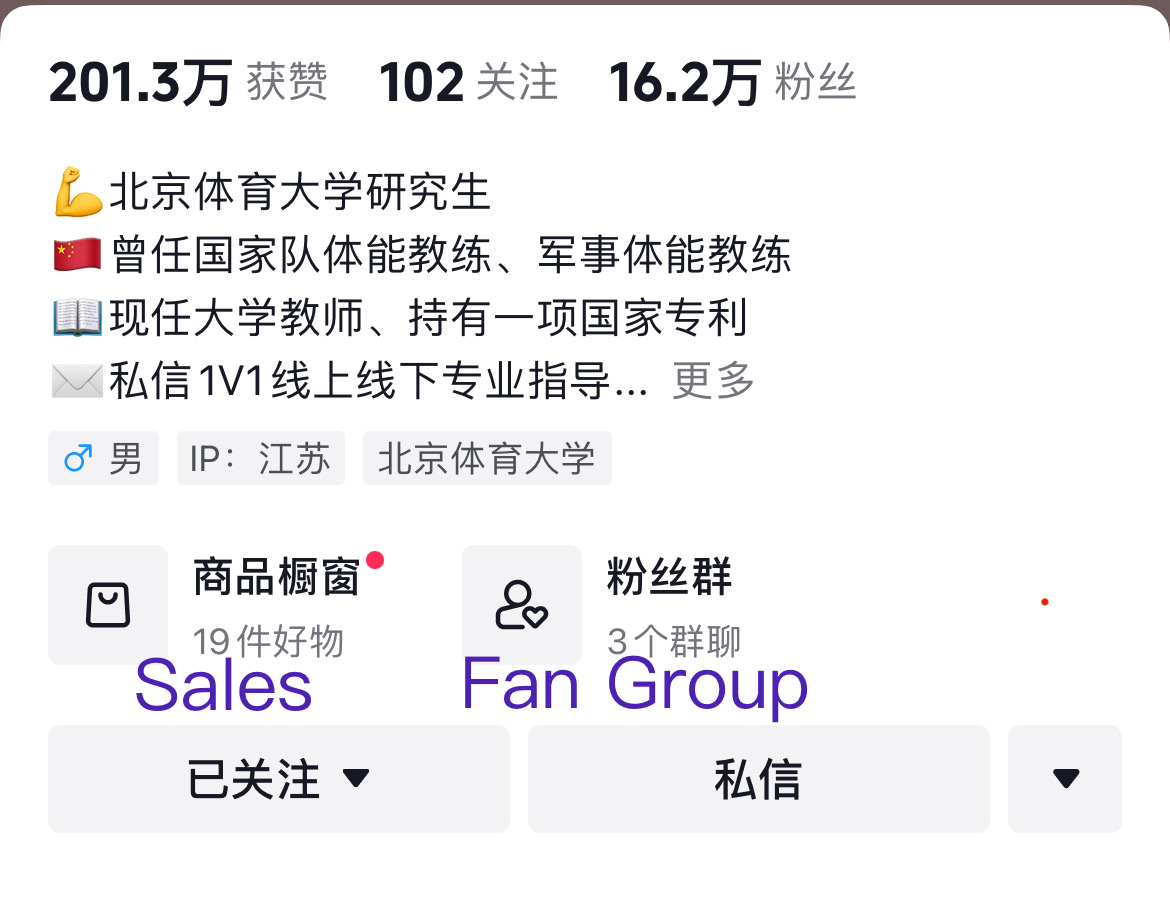
I call it “invisible community” because it's formed through a recommendation algorithm, where people may not know they're in the community, but what they say and do is no different from what a community member would do: post, interact, comment, and retweet.
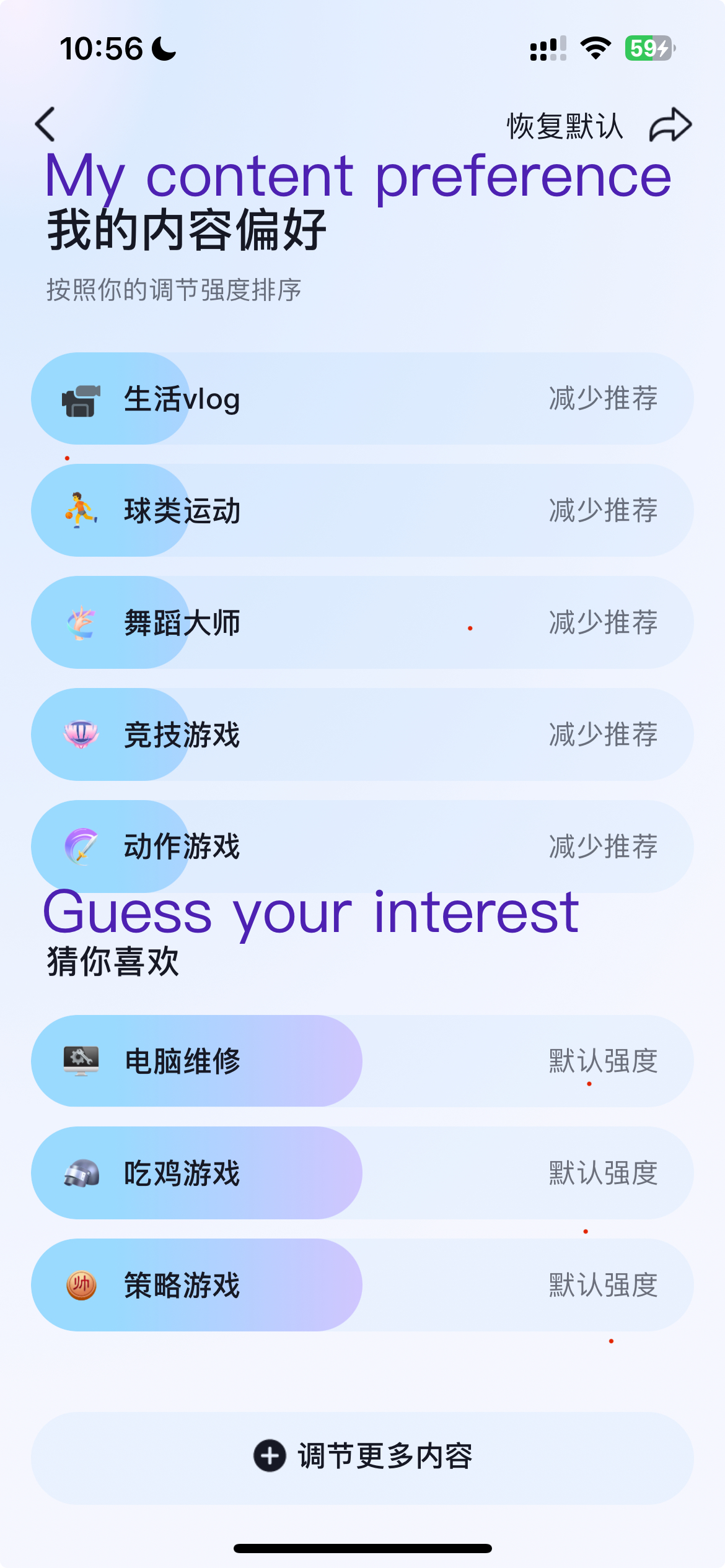
In Tik Tok, if a person wants to join a community in the "fitness space", all they have to do is search for relevant content through the platform's search engine, browse through it, and the next time they are on the homepage they will be recommended more relevant content, such as "powerlifting", "muscle hypertrophy" and "muscle mass". "Muscular hypertrophy" and "Enhanced training".
In addition to passively accepting algorithmic recommendations, the user can actively choose what he wants to know through personal customisation, and by spending time and effort on it, I think he has become a member of the digital community. Therefore, I emphasise that the community is formed through the actions of its members, not through the direct establishment of functions!
I deem that a community must be based on certain culture, which takes time to settle and form. I think the fitness community came into existence when Tik Tok became the most popular platform in China. Because of the popularity, a lot of influencers and users began to find various ways to draw others' attention and make probable profits, which was the most significant to establish and develop the community.
According to my own experience, fitness culture and community is a behemoth, which contains a variety of sub-cultures and subgroups,because fitness itself is a broad concept. It could be cross-fit, functional training, power-lifting, bodybuilding, etc. Every subgroups have a huge quantity of audience and participants. Normal individuals join the community to improve themselves, make profits, inspire others. Some influencers aim to promote fitness culture to people who have never learned about fitness, provide good training suggestions to people with fitness experience, help community members and potential members better develop themselves, and also help this culture to prevail at the regional/national level.
Development always aligns with challenge. In fact, a majority of challenges come from the competition of attention, because attention of fans is the most important origin of profit. The most classic example is whether some influencers are natural or not. Why is this? Because an important way to draw fans' attention is to show how you make progress through your own training and use of supplementary products, which they endorsed. However, some members may find that some influencers are not natural, and their products are in low quality. Therefore, they think that they are deceived. It is difficult to define whether this impact is large or small, because similar context collapsing by general influencers will not have a very serious impact on the entire community, but it may result in a small-scale trust crisis of the person and his products, and have a personal impact on some ordinary members of the community, such as the economy, health loss.